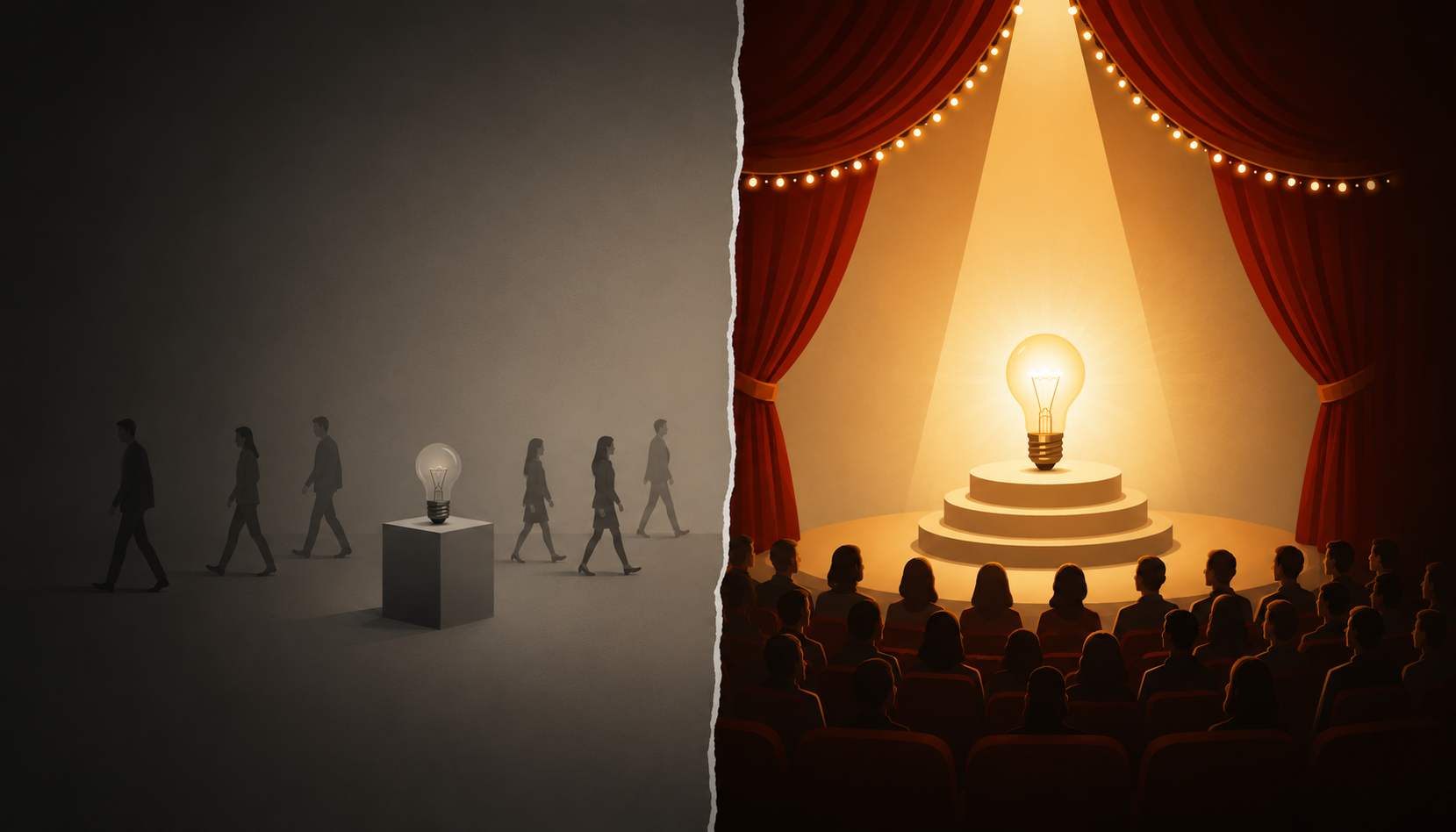
The best message rarely wins.
The best-told story does.
FOR INFLUENCE
About
The Storytelling for Influence Toolkit is your take-home companion to the workshop. It gives you the psychological research behind why story-based communication works, the three-act architecture that makes messages memorable, tools for knowing your audience, and how to use AI to sharpen and rehearse your delivery.
When to Use
Use this toolkit when you need to:
- Prepare an important presentation or conversation.
- Clarify your audience, purpose, and key message.
- Structure your story using the Three-Act Framework.
- Use AI prompts to develop, refine, and practise your story.
The following findings come from peer-reviewed research in neuroscience and psychology. They explain why stories are processed, remembered, and acted on in ways that facts and bullet points are not.
| Finding | What the science shows |
|---|---|
| NEURAL SYNC90% prediction accuracy | When a great story lands, the listener's brain activity mirrors the speaker's. Uri Hasson at Princeton found researchers could predict with 90% confidence what a listener was thinking, from brain scans alone. Being understood is literally a physical event. |
| THE TRUST CHEMICALOxytocin | Character-driven stories with a clear dramatic arc trigger oxytocin, the neurochemical of trust and empathy. Paul Zak found that oxytocin levels directly predict how much action an audience will take after hearing a message. Stories don't just move people emotionally. They move people. |
| STORIES SURVIVE63% vs 5% | In Chip and Dan Heath's research at Stanford, 63% of listeners recalled the stories from a group of one-minute speeches. Only 5% could remember any individual statistic. Stories are not just more persuasive in the moment: they're the only format that travels home with your audience. |
Stories are not a 'soft' communication choice. They activate cortisol, dopamine, and oxytocin in sequence: a neurochemical arc that primes attention, drives engagement, builds trust, and motivates action. Facts can inform. Stories change behaviour.
Your Storyteller Profile identifies your dominant archetype, your natural style for opening, building tension, and landing a message. Lean on your strengths deliberately and watch for your blind spots.
| Role | Archetype | Celebrity Match | Core Strength |
|---|---|---|---|
| The Creator | VISIONARY | Steve Jobs | Paints a future so vivid people start building before you finish talking. |
| The Hero | CHAMPION | Jacinda Ardern | Rallies people through hard things, naming the threat, taking a stand, and moving. |
| The Sage | EXPLAINER | David Attenborough | Makes the impossible obvious by finding the structure beneath the complexity. |
| The Caregiver | CONNECTOR | Oprah Winfrey | Puts a human face on everything, making people feel seen and valued. |
| The Rebel | DISRUPTOR | Greta Thunberg | Names the thing nobody wants to say, and holds the room accountable. |
| The Explorer | PIONEER | Elon Musk | Turns uncertainty into an invitation, sparking a contagious curiosity people follow. |
| The Ruler | UNIFIER | Barack Obama | Sees the whole system, finds the through-line, brings groups into alignment. |
| The Magician | TRANSFORMER | Morgan Freeman | One sentence and a whole room shifts, all effortless presence and resonance. |
Your archetype is a tool, not a label. Lean on your natural strengths in the Open and Land moves. Be deliberate about your blind spots. They're often where the most growth lives.
Your audience will generally fall into one of three cognitive modes when listening to you. Before you build your presentation, diagnose the mode, then shape your story to match it.
| Mode | How they show up | How to reach them |
|---|---|---|
| ANALYTICALRisk-assessing Reach with: Evidence |
Weighing your evidence, looking for gaps in logic. Wants credibility and rigour before buying in. | Lead with data, cite sources, acknowledge trade-offs. Show that you've thought through the risks before they have to. |
| PROTECTIVESelf-protective & uncertain Reach with: Clarity |
Focused on what changes for them personally. Wants clarity, reassurance, and control over what happens next. | Name their concern before they raise it. Be direct about what changes and what stays the same. Give them a clear next step they can own. |
| VISIONARYAspirational & open Reach with: Vision |
Already wants to act. Wants a compelling picture of what's possible and a clear first step to take. | Paint the destination vividly. Don't spend time on problems they already believe in. Get to the resolution fast and make the ask concrete. |
Before your next presentation, ask: Is my audience weighing risk, protecting themselves, or ready to move? Your answer changes where you spend time in Act 2, and how boldly you land Act 3.
The dramatic arc maps directly onto how the brain processes, encodes, and acts on information. Each act triggers a specific neurochemical response, and each must follow the last.
| Act | The Move | The Science |
|---|---|---|
| Act 1SITUATION | Set the scene: establish who the protagonist is (usually your audience), what world they're in, and what is at stake. Not background. It's the entry point into their reality. | Cortisol primes attention: the brain's stress hormone spikes at the first hint of stakes. Your audience becomes biochemically engaged before they've consciously decided to be. |
| Act 2TENSION | Raise the stakes: don't add information, create an unresolved question. Why does this matter? What happens if nothing changes? The problem should feel real, urgent, and unresolved. | Dopamine fuels curiosity: narrative uncertainty triggers dopamine release. The brain is neurologically driven to resolve open questions: a curiosity gap sustains engagement. |
| Act 3RESOLUTION | Land the message: tell your audience exactly what to think, feel, or do. Not a summary, a destination. One clear belief, one specific action. End without landing and you leave the audience incomplete. | Oxytocin builds trust: resolution releases oxytocin, the moment when trust forms and action becomes possible. Land cleanly and your message travels with them. |
Human working memory processes 3 to 4 chunks of information at a time (Cowan, 2001). Three acts. Three key points. Three next steps. Not a creative convention: a biological constraint. When you feel the urge to add a fourth point, cut it instead.
AI is not a replacement for your voice. It's a rehearsal partner. Use it to pressure-test your ideas before the room does, get feedback from your audience's perspective, and practise your delivery with live coaching.
| When | Tool | How to use it |
|---|---|---|
| IDEATEPart 1: Before you write | Microsoft Copilot | Ask Copilot to generate three different angles for your opening story. Describe your audience, their cognitive mode, and your scenario. Use the three ideas as raw material, then choose, combine, or discard based on what lands best. |
| CRITIQUEPart 3: After your first draft | Microsoft Copilot | Paste your draft presentation into Copilot. Ask it to respond as your target audience: "What's missing? What would you push back on? What would make you act on this?" Note the one change you'd make before going live. |
| REHEARSEPart 3: Before the live performance | Rehearse with Coach (PowerPoint) | Open PowerPoint's Rehearse with Coach feature. Present out loud as if the room is in front of you. Get live feedback on pace, filler words, and eye contact. Review your final coaching report before presenting for real. |
AI sharpens your story. It doesn't write it. Use AI to pressure-test and practise, but keep your voice, your examples, and your conviction at the centre. The most powerful thing in the room is always a human who believes what they're saying.